INTRODUCTION
The Department of Agadtantra is a specialized branch of Ayurveda dedicated to the study of toxicology, including the identification, classification, diagnosis, and management of various types of poisons. Agadtantra encompasses classical concepts such as Sthavara Visha (plant poisons), Jangama Visha (animal poisons), and Gara Visha (artificial poisons), along with their detailed clinical manifestations and treatment modalities.
In addition to toxicology, the department also deals with skin diseases (Twak Vikara), especially those arising due to Dushi Visha (chronic toxicity), environmental exposure, food incompatibility (Viruddha Ahara), and lifestyle factors. Patients presenting with conditions like discoloration, itching, eruptions, and allergic manifestations are managed using Ayurvedic principles including Shodhana (purification therapies), Shamana (palliative treatment), and Rasayana (rejuvenation therapy).
The department plays a vital role in both academic and clinical domains, providing training in poisoning management, forensic medicine, medico-legal aspects, and environmental toxins. It also offers patient care services, managing acute and chronic toxic conditions as well as toxin-induced dermatological disorders.
Furthermore, the department actively participates in research, public health awareness, and preventive toxicology, focusing on food safety, occupational hazards, and lifestyle-related toxicity.
Objectives
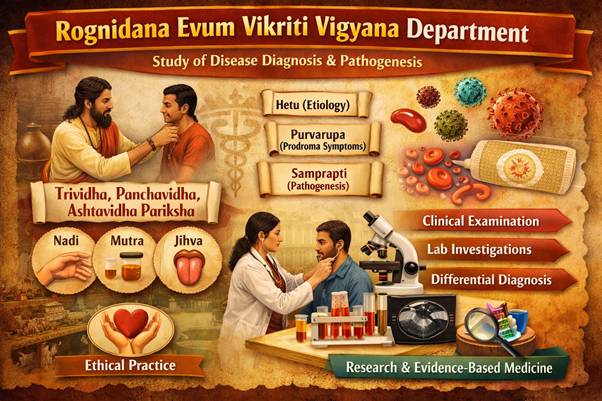
- To understand the fundamental concepts of Roga, Rogi, Nidana Panchaka, and Samprapti.
- To gain knowledge of etiology, pathogenesis, and disease classification with Ayurvedic–modern correlation.
- To develop skills in clinical examination and diagnostic methods (Trividha, Panchavidha, Ashtavidha Pariksha).
- To perform and interpret basic laboratory investigations for accurate diagnosis.
- To apply analytical thinking and diagnostic knowledge in clinical practice.
- To inculcate ethical values, communication skills, and research-oriented approach.
VISION
MISSION
- To impart comprehensive knowledge of disease diagnosis and pathogenesis as per Ayurvedic classics and modern science
- To develop analytical and clinical reasoning skills in students as per Course Outcomes (COs)
- To promote hands-on training in diagnostic methods including clinical and laboratory investigations
- To encourage evidence-based practice and research in disease diagnosis
- To inculcate ethical values, professionalism, and patient-centered approach in clinical practice
- To inculcate ethical values, communication skills, and research-oriented approach.